Unitary convolution block for ML-style stability
Tutorial goal
Show a streaming norm-preserving convolution-like block motivated by stable ML layers.
Note
New to the terminology? See the lattice DSP concept map and the causality/data-use guide for how online, offline, block, and MIMO examples should be read.
Context
Orthogonal/unitary transforms can improve numerical stability in learned models. This demo connects matrix-lattice ideas to norm-preserving convolution blocks as a DSP demonstration, not a full ML framework. Unlike a circular FFT layer, the forward map here is run by the causal online matrix-lattice runtime.
Key idea and equations
The streaming block applies a causal multichannel convolution
The all-pass condition
keeps the induced \(\ell_2\) norm controlled on the full stream:
after appending enough zero-input samples to include the tail. The finite-record adjoint diagnostic uses
which is useful for reconstruction checks but is noncausal as an online inverse.
Causality and data use
The forward map is causal and streaming. The adjoint reconstruction check is time-domain but finite-block/noncausal, which matches how adjoints are used in offline ML-style diagnostics.
What this example verifies
This verifies a DSP analogue of a norm-preserving convolution block. The forward map is causal and streaming; norm preservation is checked on the full stream with tail padding, while the adjoint reconstruction diagnostic is finite-record and noncausal.
How to read the result
Check the input/output norm figure, singular-value plot, streaming trace, and finite-adjoint error plot; a streaming unitary convolution block should preserve each batch-item norm after its tail is included.
Run command
python examples/ml_unitary_convolution_demo.py
Run status
Return code: 0
Captured stdout
batch size: 8
sequence length: 1024
channels: 6
order: 4
tail samples: 1024
real scalar parameters: 360
max streaming norm-preservation error: 5.157e-16
max finite-adjoint reconstruction error: 4.311e-14
singular value range: [1.000000, 1.000000]
causal forward: output at n uses current input and previous lattice state
finite adjoint: reconstruction is time-domain but noncausal over the block
takeaway: matrix lattice filters can parameterize streaming norm-preserving convolution blocks
Figures
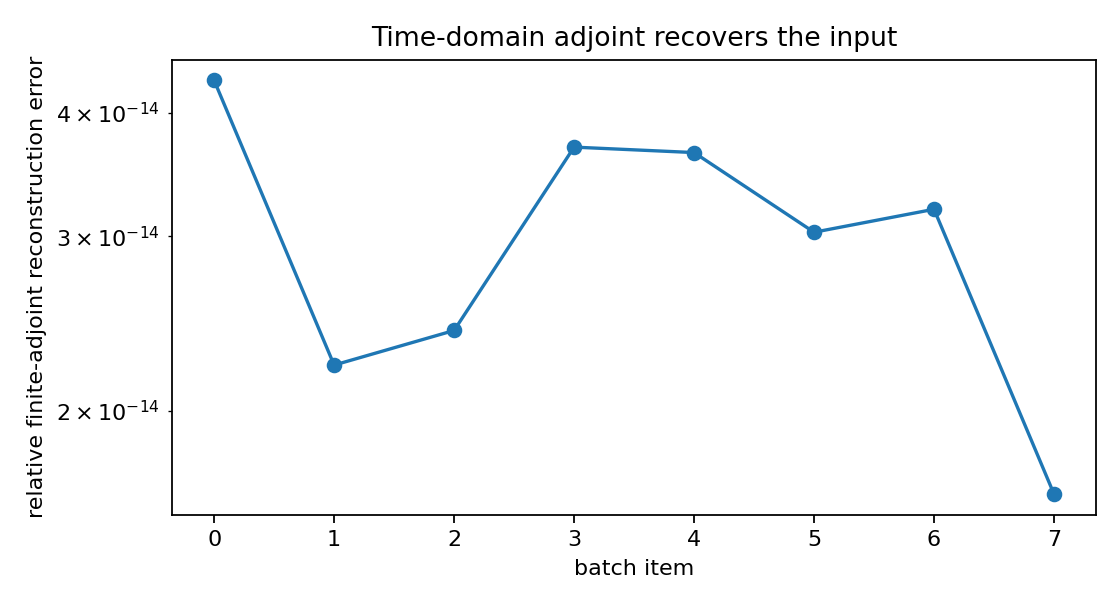
ml_unitary_convolution_adjoint_error.png
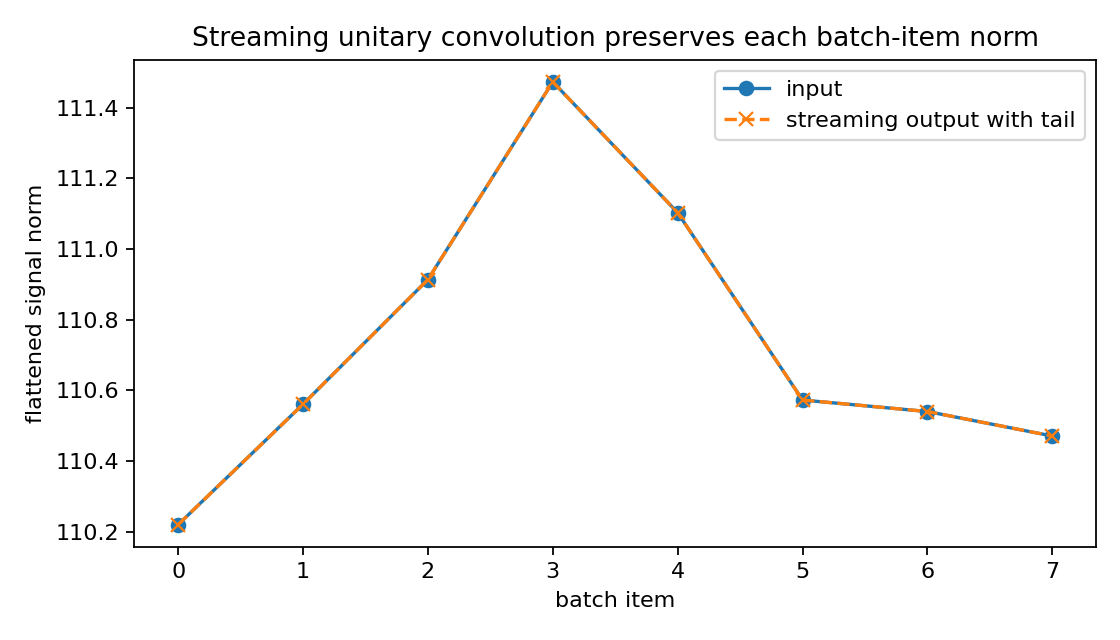
ml_unitary_convolution_batch_norms.png
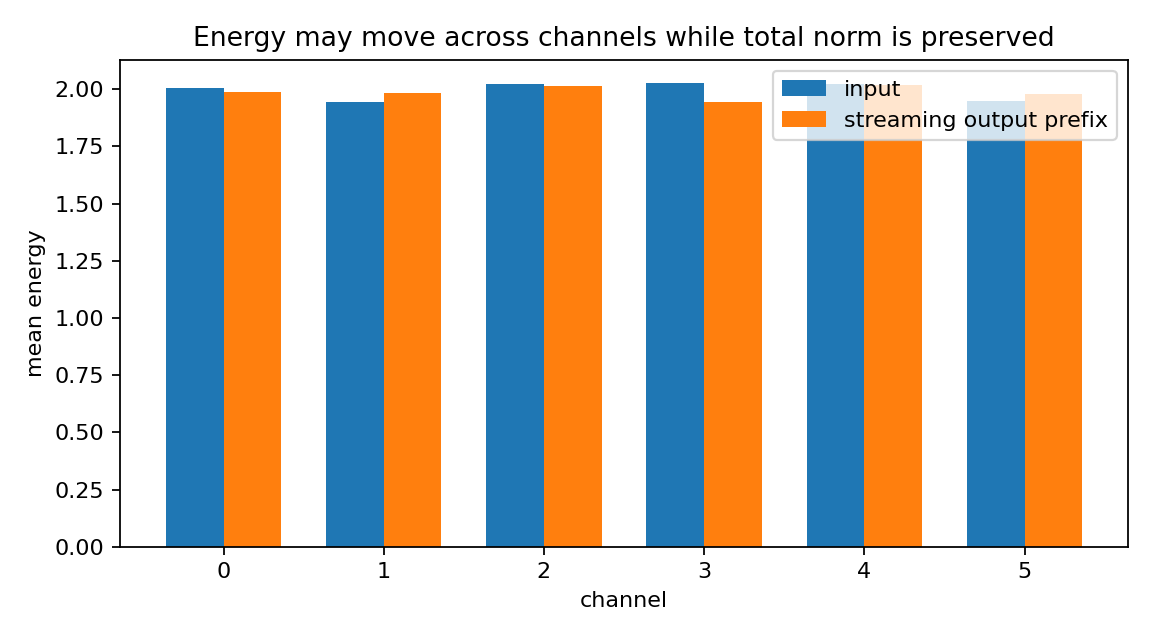
ml_unitary_convolution_channel_energy.png
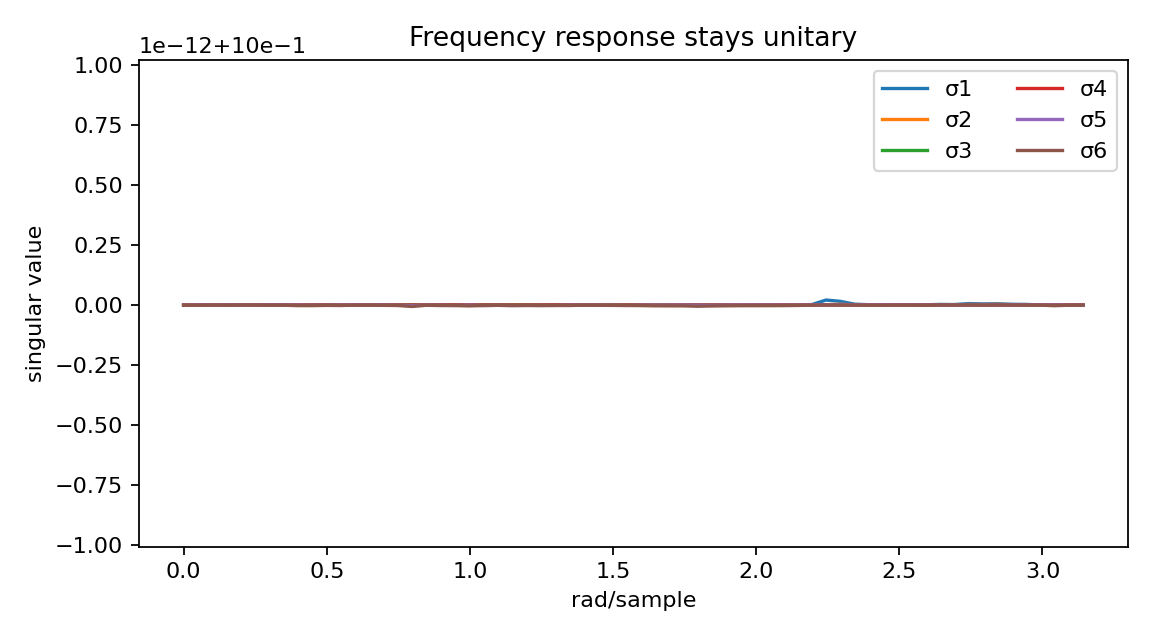
ml_unitary_convolution_singular_values.png
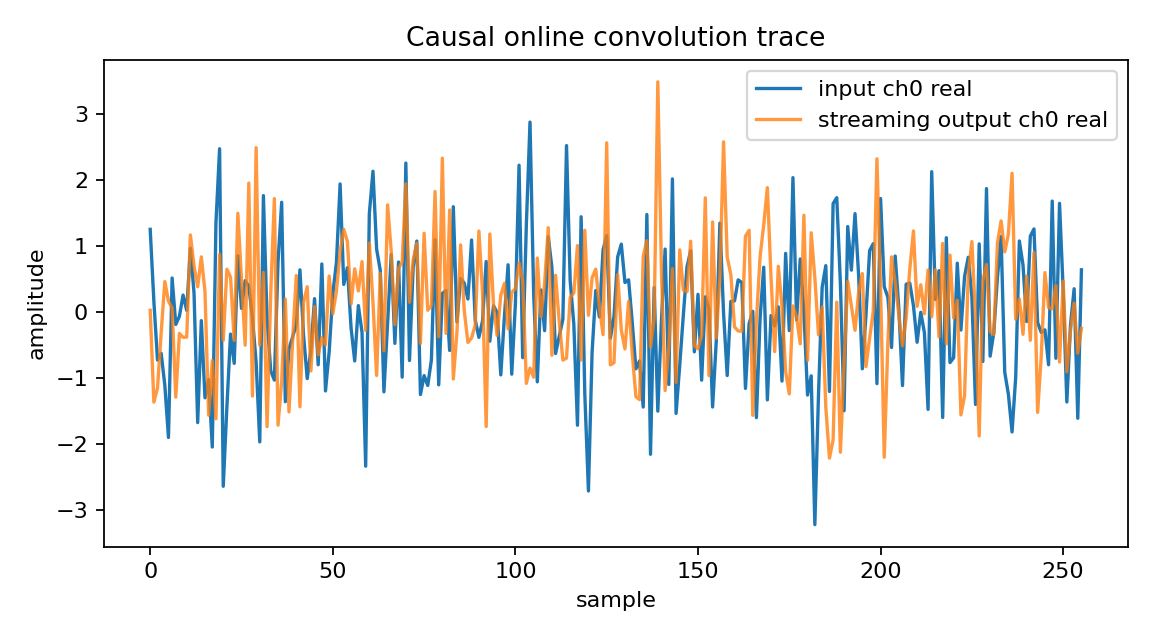
ml_unitary_convolution_streaming_trace.png
Source code
  1"""ML-adjacent streaming unitary convolution demo.
  2
  3Orthogonal/unitary convolutions are useful in ML because they preserve signal
  4norms and keep forward/adjoint maps well conditioned.  This example uses the
  5causal online matrix-lattice all-pass runtime as a streaming multichannel
  6unitary convolution block.  A finite-record time-domain adjoint is used only for
  7an offline reconstruction diagnostic.
  8"""
  9
 10from __future__ import annotations
 11
 12import os
 13from pathlib import Path
 14
 15import numpy as np
 16
 17from lattice_dsp import (
 18    MatrixLatticeAllPass,
 19    contractive_matrix_from_raw,
 20    matrix_lattice_finite_adjoint,
 21    unitary_polar_factor,
 22)
 23
 24
 25def _artifact_dir() -> Path:
 26    path = Path(os.environ.get("LATTICE_DSP_ARTIFACT_DIR", "reports/example-artifacts"))
 27    path.mkdir(parents=True, exist_ok=True)
 28    return path
 29
 30
 31def _make_filter(rng: np.random.Generator, channels: int, order: int) -> MatrixLatticeAllPass:
 32    reflections = [
 33        contractive_matrix_from_raw(
 34            0.25
 35            * (rng.normal(size=(channels, channels)) + 1j * rng.normal(size=(channels, channels)))
 36        )
 37        for _ in range(order)
 38    ]
 39    residue = unitary_polar_factor(
 40        rng.normal(size=(channels, channels)) + 1j * rng.normal(size=(channels, channels))
 41    )
 42    return MatrixLatticeAllPass(reflections, residue=residue)
 43
 44
 45def _forward_streaming(batch: np.ndarray, filt: MatrixLatticeAllPass, *, tail: int) -> np.ndarray:
 46    out = np.empty((batch.shape[0], batch.shape[1] + tail, batch.shape[2]), dtype=np.complex128)
 47    for item in range(batch.shape[0]):
 48        out[item] = filt.to_online_filter().process(batch[item], drain=tail)
 49    return out
 50
 51
 52def _finite_adjoint(
 53    batch: np.ndarray, filt: MatrixLatticeAllPass, *, tail: int, output_length: int
 54) -> np.ndarray:
 55    h = filt.impulse_response(tail)
 56    out = np.empty((batch.shape[0], output_length, batch.shape[2]), dtype=np.complex128)
 57    for item in range(batch.shape[0]):
 58        out[item] = matrix_lattice_finite_adjoint(batch[item], h, output_length=output_length)
 59    return out
 60
 61
 62def _save_figures(
 63    *,
 64    input_norms: np.ndarray,
 65    output_norms: np.ndarray,
 66    x: np.ndarray,
 67    y: np.ndarray,
 68    x_hat: np.ndarray,
 69    omega_probe: np.ndarray,
 70    singular_values: np.ndarray,
 71) -> None:
 72    try:
 73        import matplotlib.pyplot as plt
 74    except ImportError:  # pragma: no cover - optional plotting dependency
 75        print("matplotlib is not installed; skipped figures")
 76        return
 77
 78    out_dir = _artifact_dir()
 79
 80    fig, ax = plt.subplots(figsize=(7.0, 4.0))
 81    batch = np.arange(len(input_norms))
 82    ax.plot(batch, input_norms, marker="o", label="input")
 83    ax.plot(batch, output_norms, marker="x", linestyle="--", label="streaming output with tail")
 84    ax.set_xlabel("batch item")
 85    ax.set_ylabel("flattened signal norm")
 86    ax.set_title("Streaming unitary convolution preserves each batch-item norm")
 87    ax.legend(loc="best")
 88    fig.tight_layout()
 89    path = out_dir / "ml_unitary_convolution_batch_norms.png"
 90    fig.savefig(path, dpi=160)
 91    plt.close(fig)
 92    print(f"wrote {path}")
 93
 94    fig, ax = plt.subplots(figsize=(7.2, 4.0))
 95    for idx in range(singular_values.shape[1]):
 96        ax.plot(omega_probe, singular_values[:, idx], label=f"σ{idx + 1}")
 97    ax.set_xlabel("rad/sample")
 98    ax.set_ylabel("singular value")
 99    ax.set_title("Frequency response stays unitary")
100    ax.legend(loc="best", ncol=2)
101    fig.tight_layout()
102    path = out_dir / "ml_unitary_convolution_singular_values.png"
103    fig.savefig(path, dpi=160)
104    plt.close(fig)
105    print(f"wrote {path}")
106
107    channel_energy_in = np.mean(np.abs(x) ** 2, axis=(0, 1))
108    channel_energy_out = np.mean(np.abs(y[:, : x.shape[1]]) ** 2, axis=(0, 1))
109    fig, ax = plt.subplots(figsize=(7.2, 4.0))
110    idx = np.arange(len(channel_energy_in))
111    width = 0.36
112    ax.bar(idx - width / 2, channel_energy_in, width=width, label="input")
113    ax.bar(idx + width / 2, channel_energy_out, width=width, label="streaming output prefix")
114    ax.set_xlabel("channel")
115    ax.set_ylabel("mean energy")
116    ax.set_title("Energy may move across channels while total norm is preserved")
117    ax.legend(loc="best")
118    fig.tight_layout()
119    path = out_dir / "ml_unitary_convolution_channel_energy.png"
120    fig.savefig(path, dpi=160)
121    plt.close(fig)
122    print(f"wrote {path}")
123
124    reconstruction = np.linalg.norm((x_hat - x).reshape(x.shape[0], -1), axis=1) / input_norms
125    fig, ax = plt.subplots(figsize=(7.0, 3.8))
126    ax.semilogy(np.maximum(reconstruction, 1e-18), marker="o")
127    ax.set_xlabel("batch item")
128    ax.set_ylabel("relative finite-adjoint reconstruction error")
129    ax.set_title("Time-domain adjoint recovers the input")
130    fig.tight_layout()
131    path = out_dir / "ml_unitary_convolution_adjoint_error.png"
132    fig.savefig(path, dpi=160)
133    plt.close(fig)
134    print(f"wrote {path}")
135
136    fig, ax = plt.subplots(figsize=(7.2, 4.0))
137    span = min(256, x.shape[1])
138    ax.plot(np.real(x[0, :span, 0]), label="input ch0 real")
139    ax.plot(np.real(y[0, :span, 0]), label="streaming output ch0 real", alpha=0.8)
140    ax.set_xlabel("sample")
141    ax.set_ylabel("amplitude")
142    ax.set_title("Causal online convolution trace")
143    ax.legend(loc="best")
144    fig.tight_layout()
145    path = out_dir / "ml_unitary_convolution_streaming_trace.png"
146    fig.savefig(path, dpi=160)
147    plt.close(fig)
148    print(f"wrote {path}")
149
150
151rng = np.random.default_rng(314)
152batch_size = 8
153sequence_length = 1024
154channels = 6
155order = 4
156tail = 1024
157
158filt = _make_filter(rng, channels, order)
159x = rng.normal(size=(batch_size, sequence_length, channels)) + 1j * rng.normal(
160    size=(batch_size, sequence_length, channels)
161)
162y = _forward_streaming(x, filt, tail=tail)
163x_hat = _finite_adjoint(y, filt, tail=tail, output_length=sequence_length)
164
165input_norms = np.linalg.norm(x.reshape(batch_size, -1), axis=1)
166output_norms = np.linalg.norm(y.reshape(batch_size, -1), axis=1)
167max_norm_error = float(np.max(np.abs(output_norms - input_norms) / input_norms))
168max_adjoint_error = float(
169    np.max(np.linalg.norm((x_hat - x).reshape(batch_size, -1), axis=1) / input_norms)
170)
171
172omega_probe = np.linspace(0.0, np.pi, 64)
173response = filt.frequency_response(omega_probe)
174singular_values = np.linalg.svd(response, compute_uv=False)
175
176print("batch size:", batch_size)
177print("sequence length:", sequence_length)
178print("channels:", channels)
179print("order:", order)
180print("tail samples:", tail)
181print("real scalar parameters:", filt.parameter_count())
182print("max streaming norm-preservation error:", f"{max_norm_error:.3e}")
183print("max finite-adjoint reconstruction error:", f"{max_adjoint_error:.3e}")
184print("singular value range:", f"[{singular_values.min():.6f}, {singular_values.max():.6f}]")
185print("causal forward: output at n uses current input and previous lattice state")
186print("finite adjoint: reconstruction is time-domain but noncausal over the block")
187print(
188    "takeaway: matrix lattice filters can parameterize streaming norm-preserving convolution blocks"
189)
190
191_save_figures(
192    input_norms=input_norms,
193    output_norms=output_norms,
194    x=x,
195    y=y,
196    x_hat=x_hat,
197    omega_probe=omega_probe,
198    singular_values=singular_values,
199)