MIMO lattice response versus block Levinson AR
Tutorial goal
Compare two matrix-valued views: all-pass lattice filtering and vector AR estimation.
Note
New to the terminology? See the lattice DSP concept map and the causality/data-use guide for how online, offline, block, and MIMO examples should be read.
Context
This tutorial puts MIMO/matrix lattice objects next to multichannel AR estimation. They are different models, but both rely on matrix-valued stability or reflection ideas.
Key idea and equations
The block-Levinson side fits a predictive VAR model
whose stability is checked through the companion matrix \(C_A\):
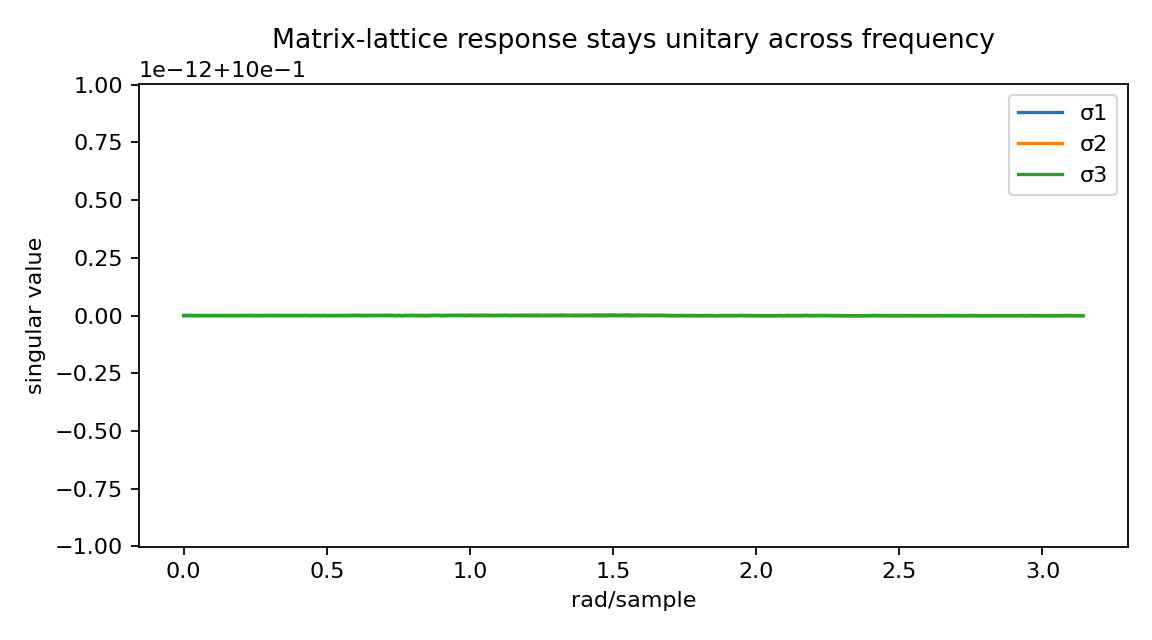
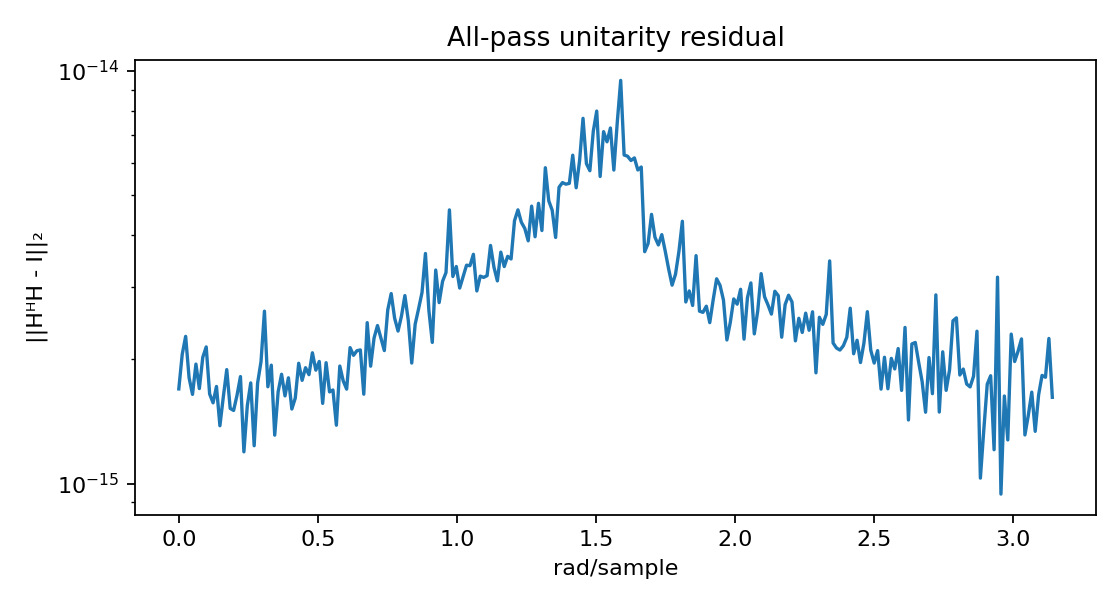
The matrix-lattice side uses reflection matrices \(K_i\) with \(\lVert K_i\rVert_2<1\) to build a frequency response \(G(z)\). In this all-pass diagnostic example, the desired property is
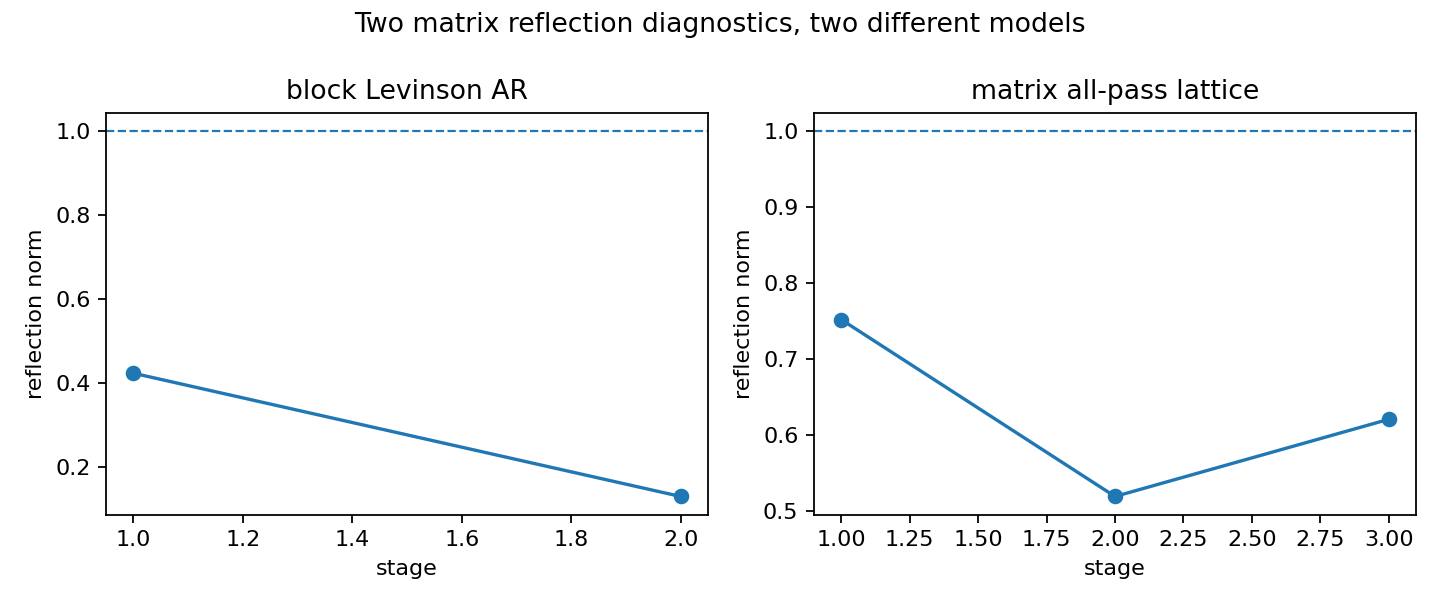
The point of the example is not to claim that the two constructions are the same model. It places their diagnostics side by side: VAR prediction error and companion stability versus lattice reflection norms and frequency-wise unitarity.
Causality and data use
The block-Levinson side is batch coefficient estimation from covariance data. The matrix-lattice side evaluates a response on a frequency grid. This page compares diagnostics; it is not a sample-by-sample runtime filter.
What this example verifies
This is a side-by-side diagnostic, not an equivalence proof. It verifies the VAR side with block-Levinson prediction diagnostics and the matrix-lattice side with contractive reflection norms and frequency-wise unitarity.
How to read the result
Use the reflection-norm and singular-value figures to separate the two diagnostics: block Levinson validates VAR prediction, while the matrix lattice validates frequency-wise unitarity.
Run command
python examples/mimo_lattice_vs_block_levinson.py
Run status
Return code: 0
Captured stdout
channels: 3
block Levinson order: 2
block Levinson/direct coefficient difference: 1.614e-16
block Levinson reflection norms: [0.42297  0.129587]
matrix all-pass lattice order: 3
matrix all-pass max reflection norm: 0.751394
matrix all-pass unitarity error: 9.488e-15
takeaway: block Levinson validates MIMO AR prediction; matrix lattice covers unitary MIMO filtering
Figures
mimo_lattice_vs_block_reflection_norms.png
mimo_lattice_vs_block_singular_values.png
mimo_lattice_vs_block_unitarity_error.png
Source code
  1"""Side-by-side MIMO lattice and block Levinson demonstrations.
  2
  3The two algorithms are complementary rather than interchangeable:
  4
  5* block Levinson estimates vector AR predictors from block Toeplitz covariance;
  6* matrix lattice all-pass filters represent unitary/paraunitary MIMO responses.
  7
  8Both expose matrix reflection-style parameters, which is why they belong in the
  9same package family.
 10"""
 11
 12from __future__ import annotations
 13
 14import os
 15from pathlib import Path
 16
 17import numpy as np
 18
 19import lattice_dsp as ld
 20
 21
 22def _artifact_dir() -> Path:
 23    path = Path(os.environ.get("LATTICE_DSP_ARTIFACT_DIR", "reports/example-artifacts"))
 24    path.mkdir(parents=True, exist_ok=True)
 25    return path
 26
 27
 28def simulate_var(coefficients: list[np.ndarray], samples: int, seed: int = 0) -> np.ndarray:
 29    rng = np.random.default_rng(seed)
 30    order = len(coefficients)
 31    channels = coefficients[0].shape[0]
 32    x = np.zeros((samples + 256, channels))
 33    noise = rng.normal(size=x.shape)
 34    for n in range(order, x.shape[0]):
 35        y = noise[n].copy()
 36        for lag, a_lag in enumerate(coefficients, start=1):
 37            y -= a_lag @ x[n - lag]
 38        x[n] = y
 39    return x[256:]
 40
 41
 42def _save_figures(
 43    *,
 44    w: np.ndarray,
 45    h: np.ndarray,
 46    levinson: ld.MultichannelARResult,
 47    lattice_reflection_norms: np.ndarray,
 48) -> None:
 49    try:
 50        import matplotlib.pyplot as plt
 51    except ImportError:  # pragma: no cover - optional plotting dependency
 52        print("matplotlib is not installed; skipped figures")
 53        return
 54
 55    out_dir = _artifact_dir()
 56    eye = np.eye(h.shape[1])
 57    unitarity_error = np.array([np.linalg.norm(hi.conj().T @ hi - eye) for hi in h])
 58    singular_values = np.linalg.svd(h, compute_uv=False)
 59
 60    fig, axes = plt.subplots(1, 2, figsize=(9.0, 3.8))
 61    axes[0].plot(
 62        np.arange(1, len(levinson.reflection_spectral_norms) + 1),
 63        levinson.reflection_spectral_norms,
 64        marker="o",
 65    )
 66    axes[0].axhline(1.0, linestyle="--", linewidth=1.0)
 67    axes[0].set_title("block Levinson AR")
 68    axes[0].set_xlabel("stage")
 69    axes[0].set_ylabel("reflection norm")
 70    axes[1].plot(
 71        np.arange(1, len(lattice_reflection_norms) + 1), lattice_reflection_norms, marker="o"
 72    )
 73    axes[1].axhline(1.0, linestyle="--", linewidth=1.0)
 74    axes[1].set_title("matrix all-pass lattice")
 75    axes[1].set_xlabel("stage")
 76    axes[1].set_ylabel("reflection norm")
 77    fig.suptitle("Two matrix reflection diagnostics, two different models")
 78    fig.tight_layout()
 79    path = out_dir / "mimo_lattice_vs_block_reflection_norms.png"
 80    fig.savefig(path, dpi=160)
 81    plt.close(fig)
 82    print(f"wrote {path}")
 83
 84    fig, ax = plt.subplots(figsize=(7.2, 4.0))
 85    for idx in range(singular_values.shape[1]):
 86        ax.plot(w, singular_values[:, idx], label=f"σ{idx + 1}")
 87    ax.set_xlabel("rad/sample")
 88    ax.set_ylabel("singular value")
 89    ax.set_title("Matrix-lattice response stays unitary across frequency")
 90    ax.legend(loc="best")
 91    fig.tight_layout()
 92    path = out_dir / "mimo_lattice_vs_block_singular_values.png"
 93    fig.savefig(path, dpi=160)
 94    plt.close(fig)
 95    print(f"wrote {path}")
 96
 97    fig, ax = plt.subplots(figsize=(7.0, 3.8))
 98    ax.semilogy(w, np.maximum(unitarity_error, 1e-18))
 99    ax.set_xlabel("rad/sample")
100    ax.set_ylabel("||HᴴH - I||₂")
101    ax.set_title("All-pass unitarity residual")
102    fig.tight_layout()
103    path = out_dir / "mimo_lattice_vs_block_unitarity_error.png"
104    fig.savefig(path, dpi=160)
105    plt.close(fig)
106    print(f"wrote {path}")
107
108
109def main() -> None:
110    # Classical MIMO AR / block Levinson side.
111    ar_coefficients = [
112        np.array([[0.36, 0.09, 0.02], [-0.04, 0.31, 0.08], [0.03, -0.06, 0.25]]),
113        np.array([[-0.12, 0.02, 0.00], [0.01, -0.10, -0.02], [0.02, 0.03, -0.08]]),
114    ]
115    x = simulate_var(ar_coefficients, samples=30000, seed=11)
116    r = ld.multichannel_autocorrelation(x, order=2)
117    direct = ld.solve_block_yule_walker_direct(r, order=2)
118    levinson = ld.block_levinson_durbin(r, order=2)
119    block_diff = np.linalg.norm(direct.coefficients - levinson.coefficients)
120
121    # Matrix all-pass lattice side.
122    rng = np.random.default_rng(12)
123    channels = 3
124    order = 3
125    reflections = []
126    for _ in range(order):
127        raw = 0.25 * (
128            rng.standard_normal((channels, channels))
129            + 1j * rng.standard_normal((channels, channels))
130        )
131        reflections.append(ld.contractive_matrix_from_raw(raw))
132    residue = ld.unitary_polar_factor(
133        rng.standard_normal((channels, channels)) + 1j * rng.standard_normal((channels, channels))
134    )
135    filt = ld.MatrixLatticeAllPass(reflections, residue)
136    w = np.linspace(0, np.pi, 256)
137    h = filt.frequency_response(w)
138    eye = np.eye(channels)
139    unitarity_error = max(np.linalg.norm(hi.conj().T @ hi - eye) for hi in h)
140    lattice_reflection_norms = np.array(
141        [np.linalg.svd(k, compute_uv=False)[0] for k in reflections]
142    )
143
144    print("channels:", channels)
145    print("block Levinson order:", levinson.order)
146    print("block Levinson/direct coefficient difference:", f"{block_diff:.3e}")
147    print("block Levinson reflection norms:", np.round(levinson.reflection_spectral_norms, 6))
148    print("matrix all-pass lattice order:", order)
149    print("matrix all-pass max reflection norm:", f"{lattice_reflection_norms.max():.6f}")
150    print("matrix all-pass unitarity error:", f"{unitarity_error:.3e}")
151    print(
152        "takeaway: block Levinson validates MIMO AR prediction; matrix lattice covers unitary MIMO filtering"
153    )
154
155    _save_figures(w=w, h=h, levinson=levinson, lattice_reflection_norms=lattice_reflection_norms)
156
157
158if __name__ == "__main__":
159    main()