Multichannel AR with block Levinson-Durbin
Tutorial goal
Estimate a vector AR model and compare block Levinson against a dense block-Toeplitz solve.
Note
New to the terminology? See the lattice DSP concept map and the causality/data-use guide for how online, offline, block, and MIMO examples should be read.
Context
Scalar AR models generalize to vector autoregressive models where each lag coefficient is a matrix. This tutorial shows how block Toeplitz structure and matrix reflection coefficients enter the multichannel setting.
Key idea and equations
Let \(x[n]\in\mathbb{R}^c\) be a vector signal and let
\(e[n]\) be the prediction residual. An order-p vector AR model is
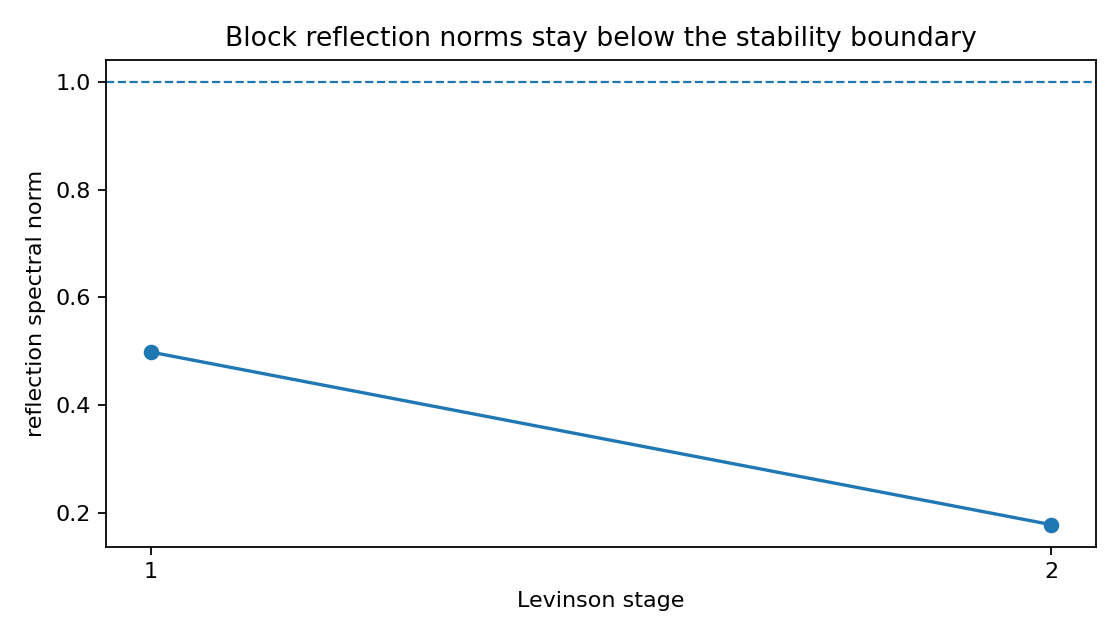
The sample autocovariances \(R_\ell=\mathbb{E}\{x[n]x[n-\ell]^T\}\) form a block-Toeplitz Yule–Walker system for the matrices \(A_1,\ldots,A_p\). Block Levinson–Durbin solves this system recursively and also exposes matrix reflection coefficients \(K_i\). The scalar condition \(|k_i|<1\) becomes the practical matrix diagnostic
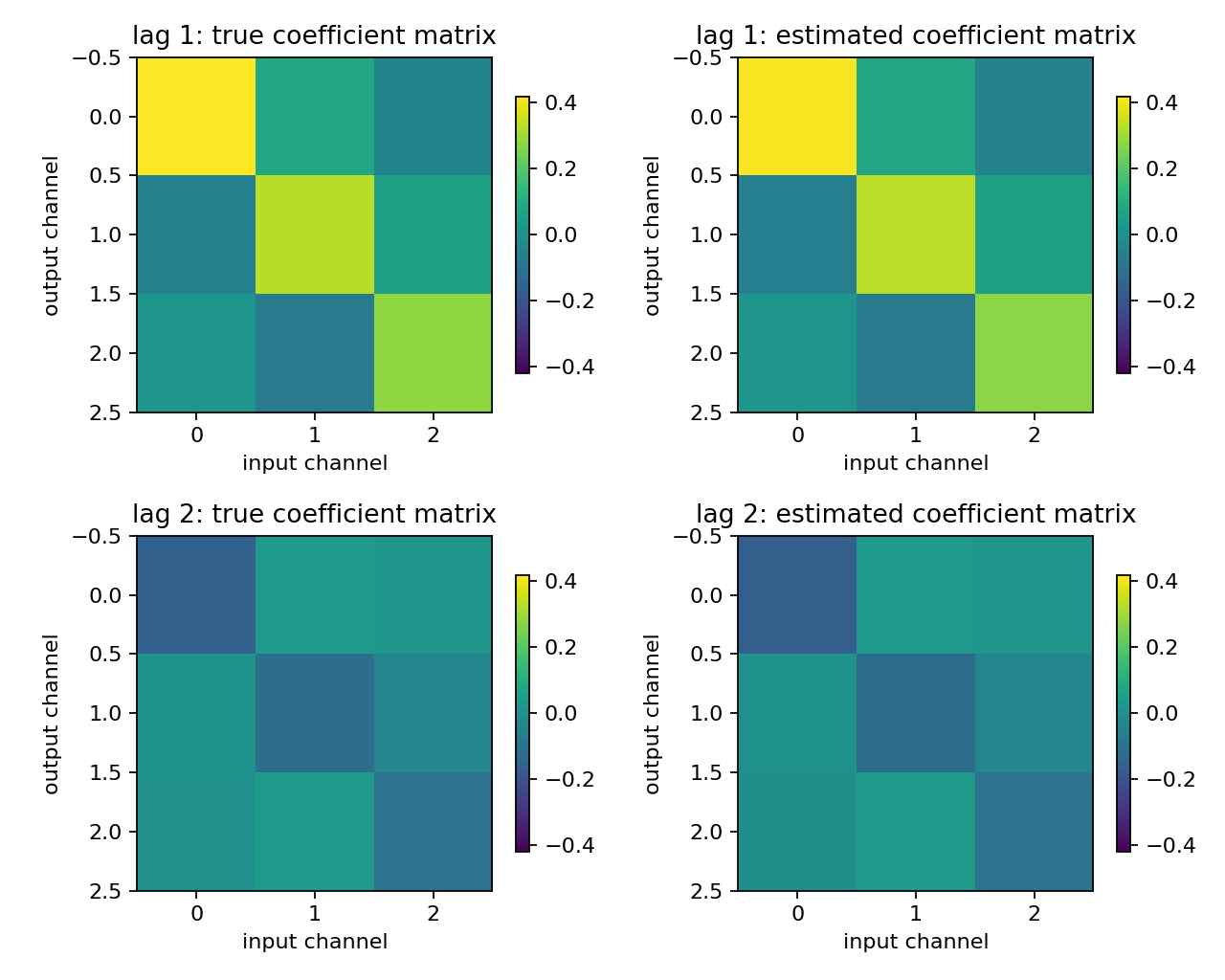
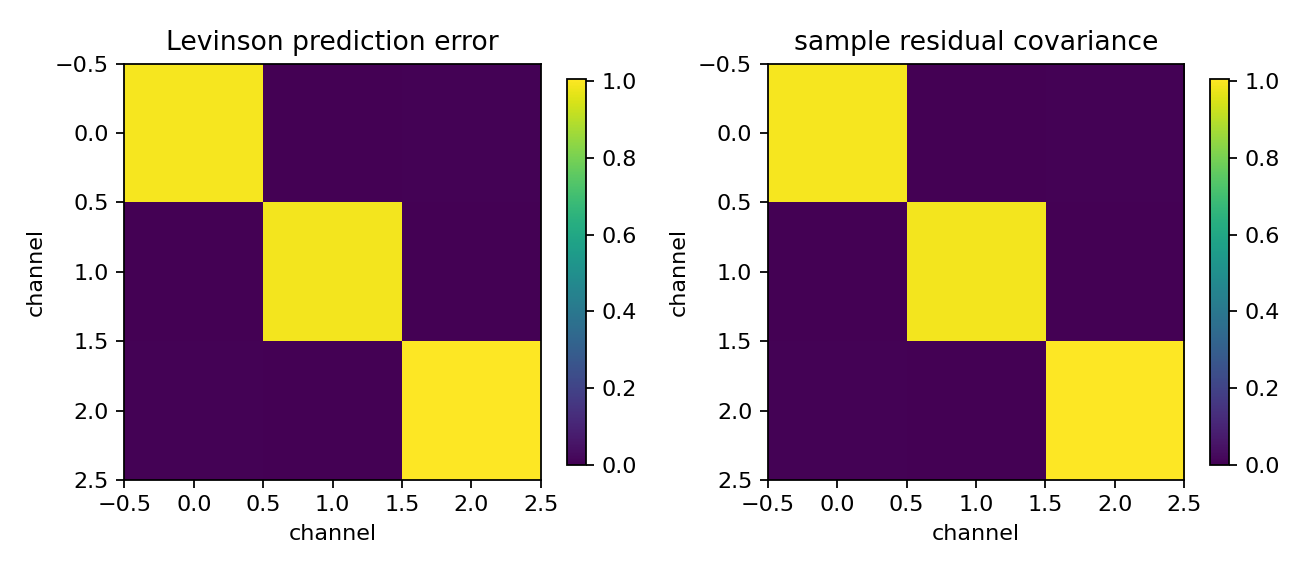
The coefficient heatmaps show the estimated \(A_k\); the reflection plot checks the stage norms; the residual-covariance plot checks the remaining multichannel prediction error.
Causality and data use
multichannel_autocorrelation and block_levinson_durbin are batch estimation steps: they use a finite multichannel record or covariance sequence. The fitted VAR recursion is causal after the matrices are known, because prediction uses only past samples x[n-k] and the current state/history.
What this example verifies
This verifies the batch multichannel AR estimator. The block Levinson result is compared with a dense block-Toeplitz solve, reflection spectral norms are checked, and the residual covariance shows what cross-channel prediction error remains after fitting.
How to read the result
Check the coefficient difference against the direct solve, then use the coefficient heatmaps, reflection-norm plot, and residual-covariance plot to see what the matrix AR fit learned.
Run command
python examples/multichannel_levinson_ar.py
Run status
Return code: 0
Captured stdout
channels: 3
order: 2
companion spectral radius: 0.635633
direct/block-Levinson coefficient difference: 7.425e-17
relative coefficient error vs true VAR: 2.791e-02
reflection spectral norms: [0.498023 0.177576]
prediction error covariance trace: 2.991384
sample residual variance trace: 2.991453
takeaway: block Levinson gives a classical MIMO AR/lattice baseline
Figures
multichannel_levinson_coefficients.png
multichannel_levinson_reflection_norms.png
multichannel_levinson_residual_covariance.png
Source code
  1"""Multichannel Levinson-Durbin estimation for a vector AR process."""
  2
  3from __future__ import annotations
  4
  5import os
  6from pathlib import Path
  7
  8import numpy as np
  9
 10import lattice_dsp as ld
 11
 12
 13def _artifact_dir() -> Path:
 14    path = Path(os.environ.get("LATTICE_DSP_ARTIFACT_DIR", "reports/example-artifacts"))
 15    path.mkdir(parents=True, exist_ok=True)
 16    return path
 17
 18
 19def simulate_var(coefficients: list[np.ndarray], samples: int, seed: int = 0) -> np.ndarray:
 20    rng = np.random.default_rng(seed)
 21    order = len(coefficients)
 22    channels = coefficients[0].shape[0]
 23    x = np.zeros((samples + 512, channels))
 24    noise = rng.normal(size=x.shape)
 25    for n in range(order, x.shape[0]):
 26        value = noise[n].copy()
 27        for lag, a_lag in enumerate(coefficients, start=1):
 28            value -= a_lag @ x[n - lag]
 29        x[n] = value
 30    return x[512:]
 31
 32
 33def _save_figures(
 34    *,
 35    true_coefficients: np.ndarray,
 36    estimated_coefficients: np.ndarray,
 37    reflection_norms: np.ndarray,
 38    prediction_error: np.ndarray,
 39    residual_covariance: np.ndarray,
 40) -> None:
 41    try:
 42        import matplotlib.pyplot as plt
 43    except ImportError:  # pragma: no cover - optional plotting dependency
 44        print("matplotlib is not installed; skipped figures")
 45        return
 46
 47    out_dir = _artifact_dir()
 48
 49    order = estimated_coefficients.shape[0]
 50    fig, axes = plt.subplots(order, 2, figsize=(8.0, 3.2 * order), squeeze=False)
 51    limit = float(max(np.max(np.abs(true_coefficients)), np.max(np.abs(estimated_coefficients))))
 52    for lag in range(order):
 53        for col, (name, values) in enumerate(
 54            (("true", true_coefficients[lag]), ("estimated", estimated_coefficients[lag].real))
 55        ):
 56            ax = axes[lag, col]
 57            im = ax.imshow(values, vmin=-limit, vmax=limit)
 58            ax.set_title(f"lag {lag + 1}: {name} coefficient matrix")
 59            ax.set_xlabel("input channel")
 60            ax.set_ylabel("output channel")
 61            fig.colorbar(im, ax=ax, shrink=0.78)
 62    fig.tight_layout()
 63    path = out_dir / "multichannel_levinson_coefficients.png"
 64    fig.savefig(path, dpi=160)
 65    plt.close(fig)
 66    print(f"wrote {path}")
 67
 68    fig, ax = plt.subplots(figsize=(7.0, 4.0))
 69    stages = np.arange(1, len(reflection_norms) + 1)
 70    ax.plot(stages, reflection_norms, marker="o")
 71    ax.axhline(1.0, linestyle="--", linewidth=1.0)
 72    ax.set_xlabel("Levinson stage")
 73    ax.set_ylabel("reflection spectral norm")
 74    ax.set_title("Block reflection norms stay below the stability boundary")
 75    ax.set_xticks(stages)
 76    fig.tight_layout()
 77    path = out_dir / "multichannel_levinson_reflection_norms.png"
 78    fig.savefig(path, dpi=160)
 79    plt.close(fig)
 80    print(f"wrote {path}")
 81
 82    fig, axes = plt.subplots(1, 2, figsize=(8.2, 3.6))
 83    for ax, name, matrix in (
 84        (axes[0], "Levinson prediction error", prediction_error.real),
 85        (axes[1], "sample residual covariance", residual_covariance.real),
 86    ):
 87        im = ax.imshow(matrix)
 88        ax.set_title(name)
 89        ax.set_xlabel("channel")
 90        ax.set_ylabel("channel")
 91        fig.colorbar(im, ax=ax, shrink=0.78)
 92    fig.tight_layout()
 93    path = out_dir / "multichannel_levinson_residual_covariance.png"
 94    fig.savefig(path, dpi=160)
 95    plt.close(fig)
 96    print(f"wrote {path}")
 97
 98
 99def main() -> None:
100    true_coefficients = [
101        np.array([[0.42, 0.08, -0.04], [-0.05, 0.33, 0.06], [0.02, -0.07, 0.28]]),
102        np.array([[-0.16, 0.03, 0.02], [0.01, -0.12, -0.03], [0.00, 0.04, -0.10]]),
103    ]
104    x = simulate_var(true_coefficients, samples=40000, seed=7)
105    r = ld.multichannel_autocorrelation(x, order=2, biased=True, demean=True)
106
107    direct = ld.solve_block_yule_walker_direct(r, order=2)
108    levinson = ld.block_levinson_durbin(r, order=2)
109    residual = ld.multichannel_prediction_error(x, levinson.coefficients)
110
111    true_stack = np.asarray(true_coefficients)
112    coeff_rel_error = np.linalg.norm(levinson.coefficients.real - true_stack) / np.linalg.norm(
113        true_stack
114    )
115    solver_agreement = np.linalg.norm(levinson.coefficients - direct.coefficients)
116    residual_covariance = np.cov(residual.T)
117
118    print("channels:", x.shape[1])
119    print("order:", levinson.order)
120    print(
121        "companion spectral radius:", f"{ld.companion_spectral_radius(levinson.coefficients):.6f}"
122    )
123    print("direct/block-Levinson coefficient difference:", f"{solver_agreement:.3e}")
124    print("relative coefficient error vs true VAR:", f"{coeff_rel_error:.3e}")
125    print("reflection spectral norms:", np.round(levinson.reflection_spectral_norms, 6))
126    print("prediction error covariance trace:", f"{np.trace(levinson.prediction_error).real:.6f}")
127    print("sample residual variance trace:", f"{np.trace(residual_covariance).real:.6f}")
128    print("takeaway: block Levinson gives a classical MIMO AR/lattice baseline")
129
130    _save_figures(
131        true_coefficients=true_stack,
132        estimated_coefficients=levinson.coefficients,
133        reflection_norms=levinson.reflection_spectral_norms,
134        prediction_error=levinson.prediction_error,
135        residual_covariance=residual_covariance,
136    )
137
138
139if __name__ == "__main__":
140    main()