Synthetic echo metric benchmark
Tutorial goal
Compare synthetic echo-path metrics across simple baselines and lattice-based variants.
Note
New to the terminology? See the lattice DSP concept map and the causality/data-use guide for how online, offline, block, and MIMO examples should be read.
Context
This benchmark is included to exercise metrics such as ERLE and residual MSE on a controlled synthetic problem. It is not an acoustic echo cancellation product benchmark.
Key idea and equations
ERLE is
How to read the result
Use ERLE and MSE only within this controlled synthetic setup; do not compare the numbers to production AEC systems.
Run command
python benchmarks/echo_cancellation_benchmark.py --samples 16000 --sample-rate 16000 --repeats 1 --output docs/benchmarks/generated/_artifacts/echo_metric/echo-metric.json
Run status
Return code: 0
Visual and data readout
When the benchmark gallery is built with results, this page embeds PNG summaries generated from the same JSON/CSV artifacts. The raw data stay available below as downloads so exact numbers remain reproducible without making the public page read like console output.
Figures
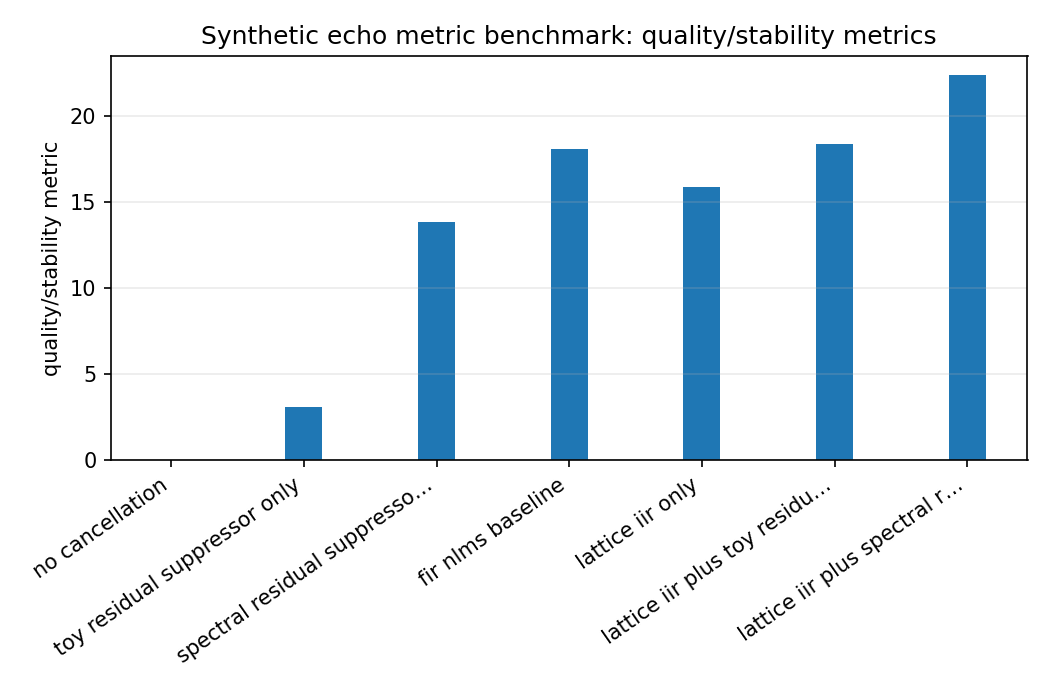
echo_metric_quality_summary.png
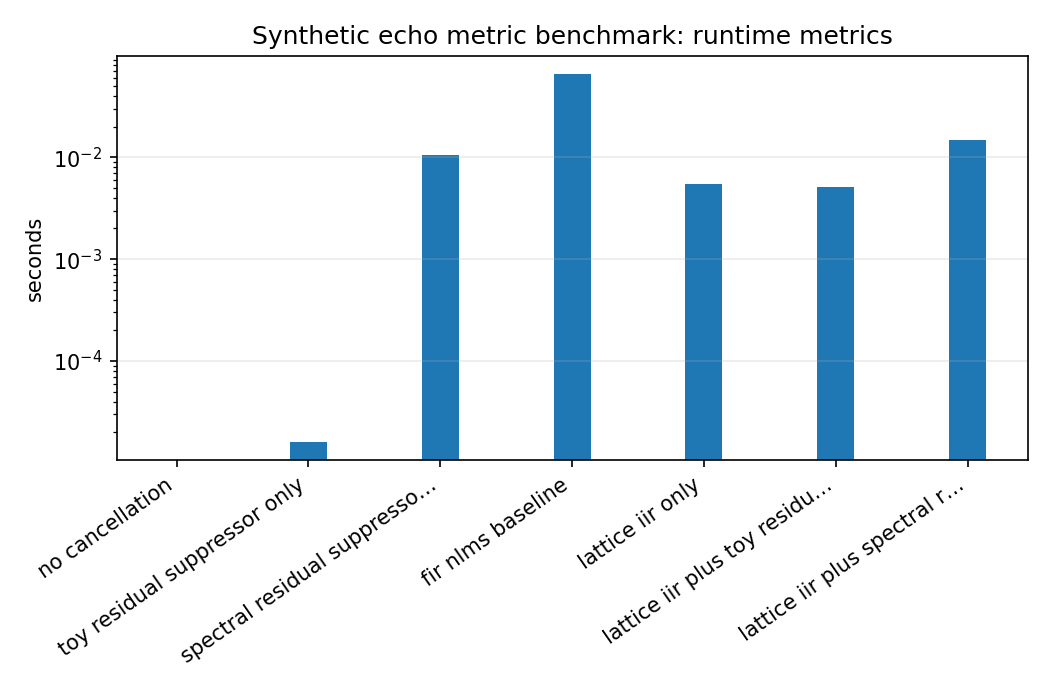
echo_metric_runtime_summary.png
Generated data files
Source code
  1"""Small synthetic echo-cancellation metric benchmark.
  2
  3The goal is to expose ERLE/MSE behavior for adaptive filters on a controlled
  4echo-like problem.  This is not a production AEC benchmark.  It compares no
  5cancellation, a simple FIR/NLMS baseline, lattice/IIR only, and small
  6dependency-free residual suppressor baselines.
  7"""
  8
  9from __future__ import annotations
 10
 11import argparse
 12import json
 13import platform
 14import statistics
 15import time
 16from collections.abc import Callable
 17from pathlib import Path
 18from typing import Any
 19
 20import numpy as np
 21
 22from lattice_dsp import (
 23    HAS_OPENMP,
 24    HybridEchoCanceller,
 25    SpectralResidualSuppressor,
 26    echo_metrics,
 27    generate_echo_problem,
 28    residual_attenuator,
 29)
 30
 31
 32def time_call(fn: Callable[[], Any], repeats: int) -> tuple[Any, dict[str, float]]:
 33    timings: list[float] = []
 34    value: Any = None
 35    for _ in range(repeats):
 36        start = time.perf_counter()
 37        value = fn()
 38        timings.append(time.perf_counter() - start)
 39    return value, {
 40        "min_s": min(timings),
 41        "median_s": statistics.median(timings),
 42        "max_s": max(timings),
 43    }
 44
 45
 46def fir_nlms(
 47    reference: np.ndarray,
 48    desired: np.ndarray,
 49    *,
 50    order: int = 64,
 51    mu: float = 0.5,
 52    epsilon: float = 1e-8,
 53) -> tuple[np.ndarray, np.ndarray, np.ndarray]:
 54    """Small FIR/NLMS baseline implemented in NumPy/Python."""
 55
 56    if order <= 0:
 57        raise ValueError("order must be positive")
 58    x = np.asarray(reference, dtype=np.float64)
 59    d = np.asarray(desired, dtype=np.float64)
 60    if x.ndim != 1 or d.ndim != 1 or x.shape != d.shape:
 61        raise ValueError("reference and desired must be equally shaped 1-D arrays")
 62
 63    w = np.zeros(order, dtype=np.float64)
 64    xbuf = np.zeros(order, dtype=np.float64)
 65    y = np.zeros_like(x)
 66    e = np.zeros_like(x)
 67    for n, sample in enumerate(x):
 68        xbuf[1:] = xbuf[:-1]
 69        xbuf[0] = sample
 70        y_n = float(np.dot(w, xbuf))
 71        e_n = float(d[n] - y_n)
 72        norm = float(np.dot(xbuf, xbuf) + epsilon)
 73        w += (mu * e_n / norm) * xbuf
 74        y[n] = y_n
 75        e[n] = e_n
 76    return y, e, w
 77
 78
 79def summarize_case(
 80    name: str,
 81    microphone: np.ndarray,
 82    enhanced: np.ndarray,
 83    clean_target: np.ndarray,
 84    timing: dict[str, float] | None = None,
 85) -> dict[str, float | str]:
 86    metrics = echo_metrics(microphone, enhanced, clean_target).as_dict()
 87    row: dict[str, float | str] = {"name": name, **metrics}
 88    if timing:
 89        row.update(timing)
 90    return row
 91
 92
 93def run_benchmark(args: argparse.Namespace) -> dict[str, Any]:
 94    # Backward-compatible defaults for tests or callers that construct the
 95    # Namespace manually instead of using ``build_parser``.
 96    for name, default in {
 97        "spectral_frame_size": 512,
 98        "spectral_hop_size": None,
 99        "spectral_floor": 0.08,
100        "spectral_over_subtract": 1.25,
101        "spectral_noise_percentile": 20.0,
102        "spectral_smoothing": 0.65,
103        "spectral_exponent": 1.0,
104        "spectral_mode": "echo_aware",
105        "spectral_echo_aware_strength": 0.85,
106        "spectral_reference_key": "echo_estimate",
107    }.items():
108        if not hasattr(args, name):
109            setattr(args, name, default)
110
111    problem = generate_echo_problem(
112        samples=args.samples,
113        sample_rate=args.sample_rate,
114        seed=args.seed,
115        nonlinear_strength=args.nonlinear_strength,
116        nonlinearity=args.nonlinearity,
117        near_end_power_ratio=args.near_end_power_ratio,
118        noise_snr_db=args.noise_snr_db,
119        double_talk=not args.no_double_talk,
120    )
121
122    cases: list[dict[str, float | str]] = []
123    cases.append(
124        summarize_case(
125            "no_cancellation",
126            problem.microphone,
127            problem.microphone,
128            problem.clean_target,
129            {"min_s": 0.0, "median_s": 0.0, "max_s": 0.0},
130        )
131    )
132
133    residual_only, residual_only_timing = time_call(
134        lambda: residual_attenuator(problem.microphone, gain=args.residual_gain),
135        args.repeats,
136    )
137    cases.append(
138        summarize_case(
139            "toy_residual_suppressor_only",
140            problem.microphone,
141            residual_only,
142            problem.clean_target,
143            residual_only_timing,
144        )
145    )
146
147    spectral_processor = SpectralResidualSuppressor(
148        frame_size=args.spectral_frame_size,
149        hop_size=args.spectral_hop_size,
150        floor=args.spectral_floor,
151        over_subtract=args.spectral_over_subtract,
152        noise_percentile=args.spectral_noise_percentile,
153        smoothing=args.spectral_smoothing,
154        exponent=args.spectral_exponent,
155        mode=args.spectral_mode,
156        echo_aware_strength=args.spectral_echo_aware_strength,
157        reference_key=args.spectral_reference_key,
158    )
159    spectral_only, spectral_only_timing = time_call(
160        lambda: spectral_processor(
161            problem.microphone,
162            {
163                "sample_rate": args.sample_rate,
164                "reference": problem.reference,
165            },
166        ),
167        args.repeats,
168    )
169    cases.append(
170        summarize_case(
171            "spectral_residual_suppressor_only",
172            problem.microphone,
173            spectral_only,
174            problem.clean_target,
175            spectral_only_timing,
176        )
177    )
178
179    fir_result, fir_timing = time_call(
180        lambda: fir_nlms(
181            problem.reference,
182            problem.microphone,
183            order=args.fir_order,
184            mu=args.fir_mu,
185            epsilon=args.epsilon,
186        ),
187        args.repeats,
188    )
189    _, fir_residual, fir_weights = fir_result
190    cases.append(
191        summarize_case(
192            "fir_nlms_baseline",
193            problem.microphone,
194            fir_residual,
195            problem.clean_target,
196            fir_timing,
197        )
198    )
199
200    def make_canceller(*, residual_mode: str | None = None) -> HybridEchoCanceller:
201        processor = None
202        if residual_mode == "toy":
203
204            def processor(residual: np.ndarray, context: dict[str, Any]) -> np.ndarray:
205                return residual_attenuator(residual, gain=args.residual_gain)
206
207        elif residual_mode == "spectral":
208            processor = spectral_processor
209        elif residual_mode is not None:
210            raise ValueError(f"unknown residual_mode: {residual_mode}")
211
212        return HybridEchoCanceller(
213            initial_reflection=[0.0] * args.iir_order,
214            initial_taps=[0.0] * (args.iir_order + 1),
215            mu_taps=args.mu_taps,
216            mu_reflection=args.mu_reflection,
217            epsilon=args.epsilon,
218            reflection_update_period=args.reflection_update_period,
219            scale_reflection_mu_by_period=not args.no_scale_reflection_mu_by_period,
220            residual_processor=processor,
221            sample_rate=args.sample_rate,
222        )
223
224    def run_lattice_only() -> Any:
225        canceller = make_canceller()
226        return canceller.process(
227            problem.reference, problem.microphone, clean_target=problem.clean_target
228        )
229
230    lattice_result, lattice_timing = time_call(run_lattice_only, args.repeats)
231    cases.append(
232        summarize_case(
233            "lattice_iir_only",
234            problem.microphone,
235            lattice_result.residual,
236            problem.clean_target,
237            lattice_timing,
238        )
239    )
240
241    def run_hybrid() -> Any:
242        canceller = make_canceller(residual_mode="toy")
243        return canceller.process(
244            problem.reference, problem.microphone, clean_target=problem.clean_target
245        )
246
247    hybrid_result, hybrid_timing = time_call(run_hybrid, args.repeats)
248    cases.append(
249        summarize_case(
250            "lattice_iir_plus_toy_residual_suppressor",
251            problem.microphone,
252            hybrid_result.enhanced,
253            problem.clean_target,
254            hybrid_timing,
255        )
256    )
257
258    def run_spectral_hybrid() -> Any:
259        canceller = make_canceller(residual_mode="spectral")
260        return canceller.process(
261            problem.reference, problem.microphone, clean_target=problem.clean_target
262        )
263
264    spectral_hybrid_result, spectral_hybrid_timing = time_call(run_spectral_hybrid, args.repeats)
265    cases.append(
266        summarize_case(
267            "lattice_iir_plus_spectral_residual_suppressor",
268            problem.microphone,
269            spectral_hybrid_result.enhanced,
270            problem.clean_target,
271            spectral_hybrid_timing,
272        )
273    )
274
275    best = max(cases, key=lambda row: float(row["erle_db"]))
276    return {
277        "metadata": {
278            "python": platform.python_version(),
279            "platform": platform.platform(),
280            "has_openmp": HAS_OPENMP,
281            "samples": args.samples,
282            "sample_rate": args.sample_rate,
283            "seed": args.seed,
284            "repeats": args.repeats,
285            "nonlinearity": args.nonlinearity,
286            "nonlinear_strength": args.nonlinear_strength,
287            "near_end_power_ratio": args.near_end_power_ratio,
288            "noise_snr_db": args.noise_snr_db,
289            "iir_order": args.iir_order,
290            "fir_order": args.fir_order,
291            "reflection_update_period": args.reflection_update_period,
292            "scale_reflection_mu_by_period": not args.no_scale_reflection_mu_by_period,
293            "residual_gain": args.residual_gain,
294            "spectral_frame_size": args.spectral_frame_size,
295            "spectral_hop_size": args.spectral_hop_size,
296            "spectral_floor": args.spectral_floor,
297            "spectral_over_subtract": args.spectral_over_subtract,
298            "spectral_noise_percentile": args.spectral_noise_percentile,
299            "spectral_smoothing": args.spectral_smoothing,
300            "spectral_exponent": args.spectral_exponent,
301            "spectral_mode": args.spectral_mode,
302            "spectral_echo_aware_strength": args.spectral_echo_aware_strength,
303            "spectral_reference_key": args.spectral_reference_key,
304            "target_reflection": problem.reflection.tolist(),
305            "target_taps": problem.taps.tolist(),
306            "fir_weight_norm": float(np.linalg.norm(fir_weights)),
307            "final_lattice_reflection": lattice_result.reflection.tolist(),
308            "final_hybrid_reflection": hybrid_result.reflection.tolist(),
309        },
310        "cases": cases,
311        "best_by_erle": best,
312    }
313
314
315def build_parser() -> argparse.ArgumentParser:
316    parser = argparse.ArgumentParser(description=__doc__)
317    parser.add_argument("--samples", type=int, default=64_000)
318    parser.add_argument("--sample-rate", type=int, default=16_000)
319    parser.add_argument("--seed", type=int, default=1234)
320    parser.add_argument("--repeats", type=int, default=3)
321    parser.add_argument(
322        "--nonlinearity", choices=["none", "tanh", "cubic", "clipped"], default="tanh"
323    )
324    parser.add_argument("--nonlinear-strength", type=float, default=0.08)
325    parser.add_argument("--near-end-power-ratio", type=float, default=0.02)
326    parser.add_argument("--noise-snr-db", type=float, default=30.0)
327    parser.add_argument("--no-double-talk", action="store_true")
328    parser.add_argument("--iir-order", type=int, default=4)
329    parser.add_argument("--fir-order", type=int, default=64)
330    parser.add_argument("--fir-mu", type=float, default=0.5)
331    parser.add_argument("--mu-taps", type=float, default=0.05)
332    parser.add_argument("--mu-reflection", type=float, default=0.001)
333    parser.add_argument("--epsilon", type=float, default=1e-8)
334    parser.add_argument("--reflection-update-period", type=int, default=8)
335    parser.add_argument("--no-scale-reflection-mu-by-period", action="store_true")
336    parser.add_argument("--residual-gain", type=float, default=0.7)
337    parser.add_argument("--spectral-frame-size", type=int, default=512)
338    parser.add_argument("--spectral-hop-size", type=int, default=None)
339    parser.add_argument("--spectral-floor", type=float, default=0.08)
340    parser.add_argument("--spectral-over-subtract", type=float, default=1.25)
341    parser.add_argument("--spectral-noise-percentile", type=float, default=20.0)
342    parser.add_argument("--spectral-smoothing", type=float, default=0.65)
343    parser.add_argument("--spectral-exponent", type=float, default=1.0)
344    parser.add_argument("--spectral-mode", choices=["echo_aware", "blind"], default="echo_aware")
345    parser.add_argument("--spectral-echo-aware-strength", type=float, default=0.85)
346    parser.add_argument(
347        "--spectral-reference-key",
348        choices=["echo_estimate", "reference"],
349        default="echo_estimate",
350        help="Context signal used by echo-aware spectral residual suppression.",
351    )
352    parser.add_argument("--output", type=Path, default=Path("reports/echo-benchmark.json"))
353    return parser
354
355
356def main() -> None:
357    parser = build_parser()
358    args = parser.parse_args()
359    payload = run_benchmark(args)
360    print(json.dumps(payload, indent=2, sort_keys=True))
361    args.output.parent.mkdir(parents=True, exist_ok=True)
362    args.output.write_text(json.dumps(payload, indent=2, sort_keys=True) + "\n", encoding="utf-8")
363    print(f"Wrote {args.output}")
364
365
366if __name__ == "__main__":
367    main()