Model reduction speed/accuracy benchmark
Tutorial goal
Reduce a full-order all-pole model and measure speed, error, SNR, and pole radius.
Note
New to the terminology? See the lattice DSP concept map and the causality/data-use guide for how online, offline, block, and MIMO examples should be read.
Context
Model reduction is a tradeoff: lower order is cheaper, but it may no longer match the original response. This benchmark is intentionally a stable baseline, not a full Nehari/AAK/Hankel-norm reducer. The lattice parameterization makes simple reflection truncation useful because it preserves scalar stability, while the theory documentation explains how Hankel-operator diagnostics connect to SISO reduction quality.
Key idea and equations
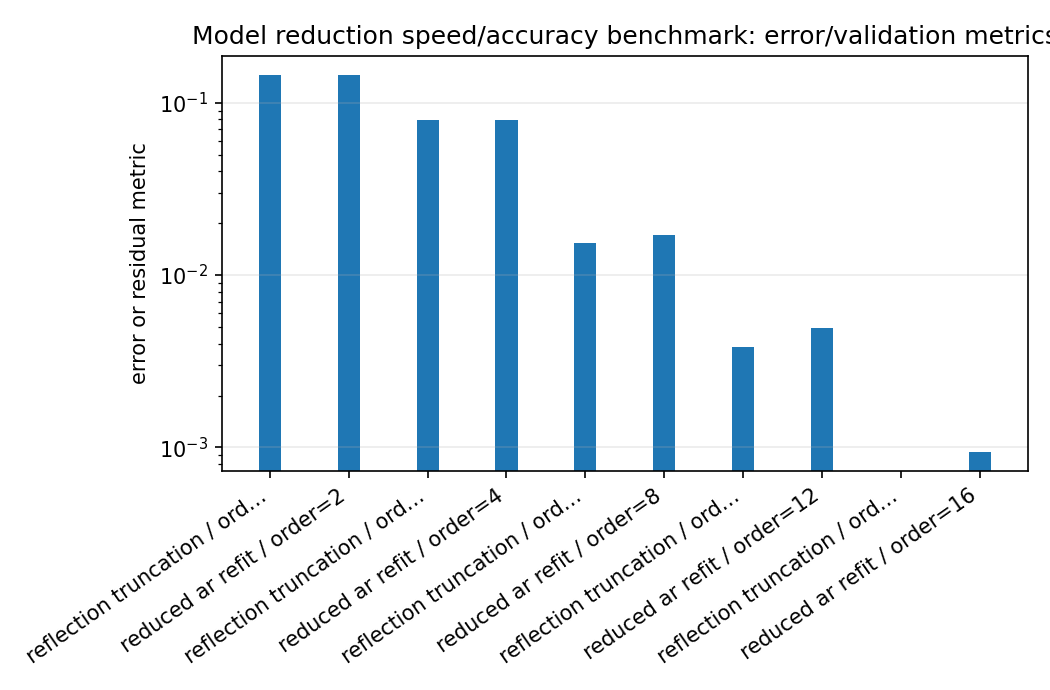
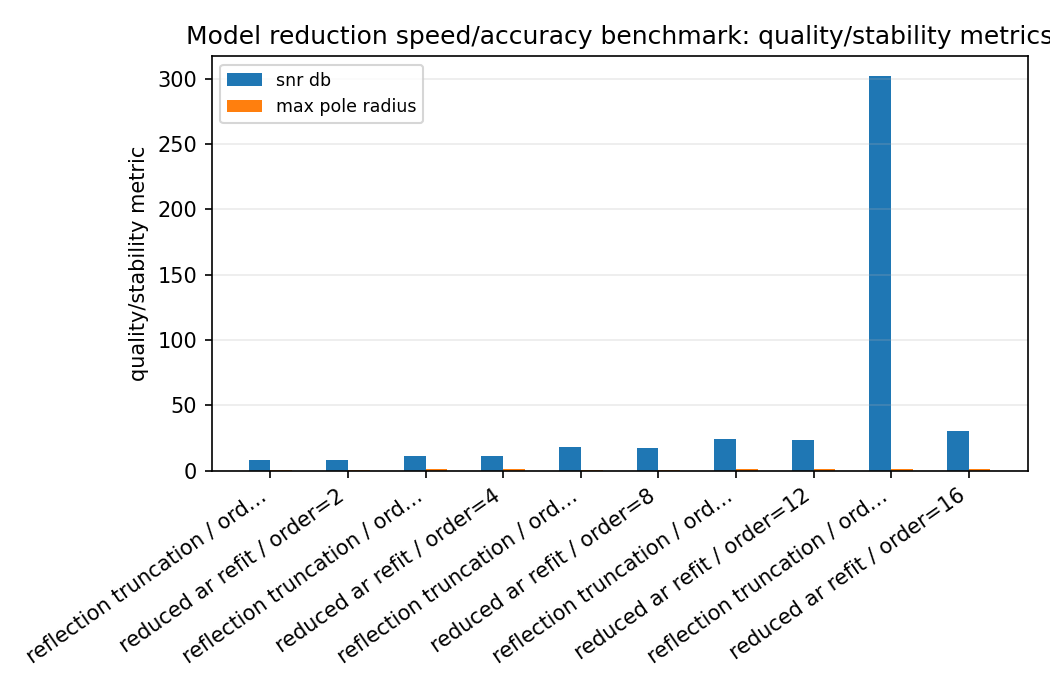
The benchmark reports relative MSE and SNR,
How to read the result
Look for the smallest order whose SNR and relative MSE are acceptable while keeping max pole radius below one. Treat this as a stable baseline, not as a Hankel/Nehari/AAK optimality claim.
Run command
python benchmarks/model_reduction_benchmark.py --full-order 16 --orders 2 4 8 12 16 --channels 32 --samples 20000 --repeats 3 --output docs/benchmarks/generated/_artifacts/model_reduction/model-reduction.json
Run status
Return code: 0
Visual and data readout
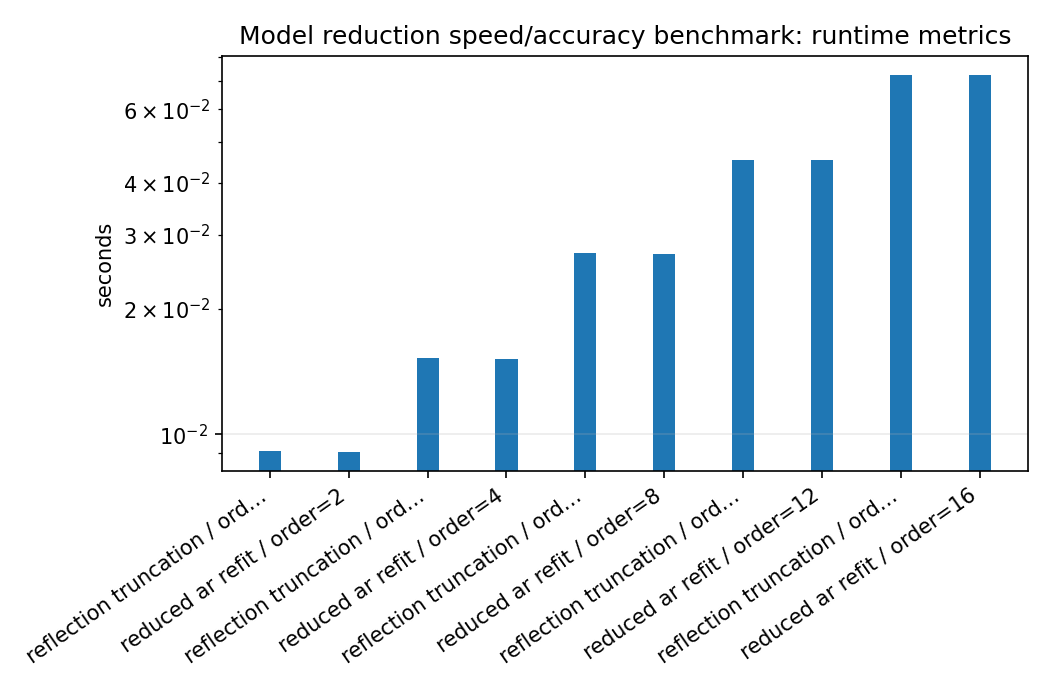
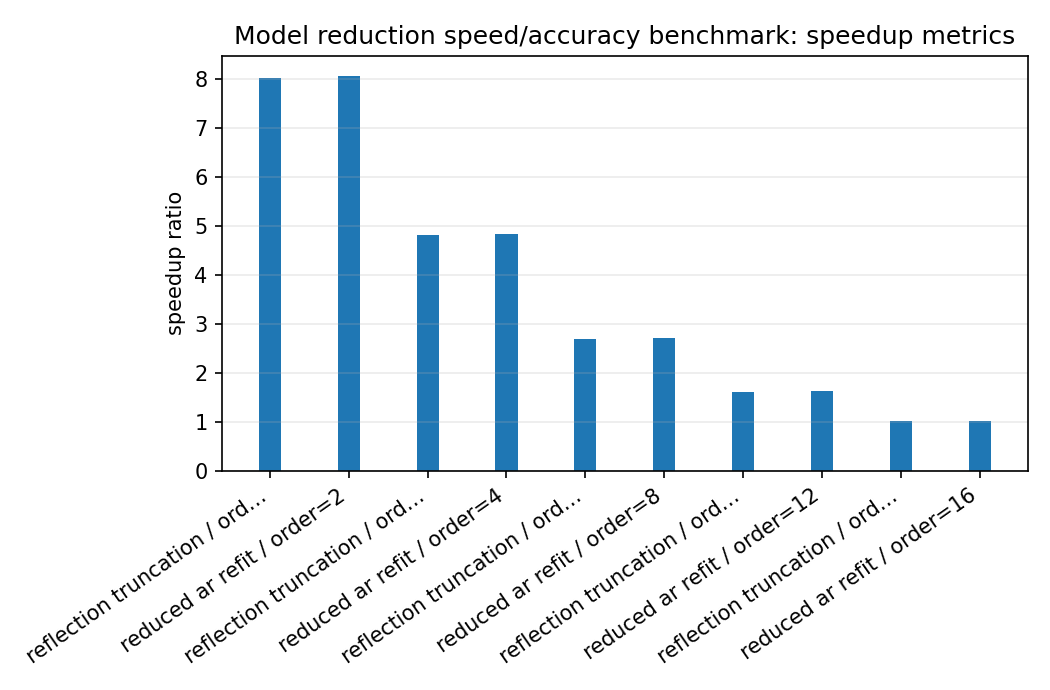
When the benchmark gallery is built with results, this page embeds PNG summaries generated from the same JSON/CSV artifacts. The raw data stay available below as downloads so exact numbers remain reproducible without making the public page read like console output.
Figures
model_reduction_error_summary.png
model_reduction_quality_summary.png
model_reduction_runtime_summary.png
model_reduction_speedup_summary.png
Generated data files
Source code
  1from __future__ import annotations
  2
  3import argparse
  4import json
  5import math
  6import platform
  7import statistics
  8import time
  9from pathlib import Path
 10
 11import numpy as np
 12import lattice_dsp as ld
 13
 14
 15def median_time(fn, repeats: int):
 16    times = []
 17    result = None
 18    for _ in range(repeats):
 19        t0 = time.perf_counter()
 20        result = fn()
 21        times.append(time.perf_counter() - t0)
 22    return statistics.median(times), result
 23
 24
 25def pole_radius(reflection):
 26    if len(reflection) == 0:
 27        return 0.0
 28    a = np.asarray(ld.reflection_to_denominator(reflection.tolist()), dtype=float)
 29    roots = np.roots(a)
 30    return float(np.max(np.abs(roots))) if roots.size else 0.0
 31
 32
 33def snr_db(reference, estimate):
 34    err = reference - estimate
 35    p_ref = float(np.mean(reference * reference))
 36    p_err = float(np.mean(err * err))
 37    return 10.0 * math.log10((p_ref + 1e-30) / (p_err + 1e-30))
 38
 39
 40def process_batch(reflection, x):
 41    numerator = [1.0] + [0.0] * len(reflection)
 42    return ld.process_batch(reflection.tolist(), numerator, x)
 43
 44
 45def main():
 46    parser = argparse.ArgumentParser()
 47    parser.add_argument("--full-order", type=int, default=16)
 48    parser.add_argument("--orders", type=int, nargs="+", default=[2, 4, 6, 8, 12, 16])
 49    parser.add_argument("--channels", type=int, default=64)
 50    parser.add_argument("--samples", type=int, default=50000)
 51    parser.add_argument("--repeats", type=int, default=5)
 52    parser.add_argument("--seed", type=int, default=123)
 53    parser.add_argument("--output", default="reports/model-reduction-results.json")
 54    args = parser.parse_args()
 55
 56    rng = np.random.default_rng(args.seed)
 57
 58    # Stable high-order all-pole model via reflection coefficients.
 59    # Magnitudes decay with order so lower-order reductions have a fair chance.
 60    decay = np.exp(-np.arange(args.full_order) / 5.0)
 61    full_reflection = 0.65 * decay * rng.uniform(-1.0, 1.0, size=args.full_order)
 62
 63    x = rng.normal(size=(args.channels, args.samples)).astype(np.float64)
 64
 65    full_time, y_full = median_time(
 66        lambda: process_batch(full_reflection, x),
 67        args.repeats,
 68    )
 69
 70    rows = []
 71
 72    for order in args.orders:
 73        if order > args.full_order:
 74            continue
 75
 76        # Method 1: stable lattice truncation.
 77        # Keep the first k reflection coefficients.
 78        trunc_reflection = full_reflection[:order].copy()
 79
 80        trunc_time, y_trunc = median_time(
 81            lambda r=trunc_reflection: process_batch(r, x),
 82            args.repeats,
 83        )
 84
 85        rows.append(
 86            {
 87                "method": "reflection_truncation",
 88                "order": order,
 89                "median_s": trunc_time,
 90                "speedup_vs_full": full_time / trunc_time,
 91                "rel_mse": float(np.mean((y_full - y_trunc) ** 2) / (np.mean(y_full**2) + 1e-30)),
 92                "snr_db": snr_db(y_full, y_trunc),
 93                "max_pole_radius": pole_radius(trunc_reflection),
 94            }
 95        )
 96
 97        # Method 2: reduced AR refit.
 98        # Estimate a reduced all-pole model from the full model's first channel.
 99        # This is often a better reduced model than simple truncation.
100        if order > 0:
101            r = ld.autocorrelation(y_full[0], order)
102            fit_reflection = np.asarray(
103                ld.levinson_durbin_reflection(r, order),
104                dtype=float,
105            )
106        else:
107            fit_reflection = np.asarray([], dtype=float)
108
109        fit_time, y_fit = median_time(
110            lambda r=fit_reflection: process_batch(r, x),
111            args.repeats,
112        )
113
114        rows.append(
115            {
116                "method": "reduced_ar_refit",
117                "order": order,
118                "median_s": fit_time,
119                "speedup_vs_full": full_time / fit_time,
120                "rel_mse": float(np.mean((y_full - y_fit) ** 2) / (np.mean(y_full**2) + 1e-30)),
121                "snr_db": snr_db(y_full, y_fit),
122                "max_pole_radius": pole_radius(fit_reflection),
123            }
124        )
125
126    result = {
127        "metadata": {
128            "python": platform.python_version(),
129            "platform": platform.platform(),
130            "has_openmp": bool(ld.HAS_OPENMP),
131            "full_order": args.full_order,
132            "channels": args.channels,
133            "samples": args.samples,
134            "repeats": args.repeats,
135            "seed": args.seed,
136            "full_median_s": full_time,
137            "full_max_pole_radius": pole_radius(full_reflection),
138        },
139        "rows": rows,
140    }
141
142    Path(args.output).parent.mkdir(parents=True, exist_ok=True)
143    Path(args.output).write_text(json.dumps(result, indent=2))
144
145    print(json.dumps(result["metadata"], indent=2))
146    print()
147    print(
148        f"{'method':24s} {'order':>5s} {'median_s':>10s} {'speedup':>9s} {'rel_mse':>12s} {'snr_db':>9s} {'pole_r':>8s}"
149    )
150    print("-" * 88)
151    for row in sorted(rows, key=lambda r: (r["method"], r["order"])):
152        print(
153            f"{row['method']:24s} "
154            f"{row['order']:5d} "
155            f"{row['median_s']:10.6f} "
156            f"{row['speedup_vs_full']:9.2f} "
157            f"{row['rel_mse']:12.3e} "
158            f"{row['snr_db']:9.2f} "
159            f"{row['max_pole_radius']:8.4f}"
160        )
161
162    print()
163    print(f"Wrote {args.output}")
164
165
166if __name__ == "__main__":
167    main()